
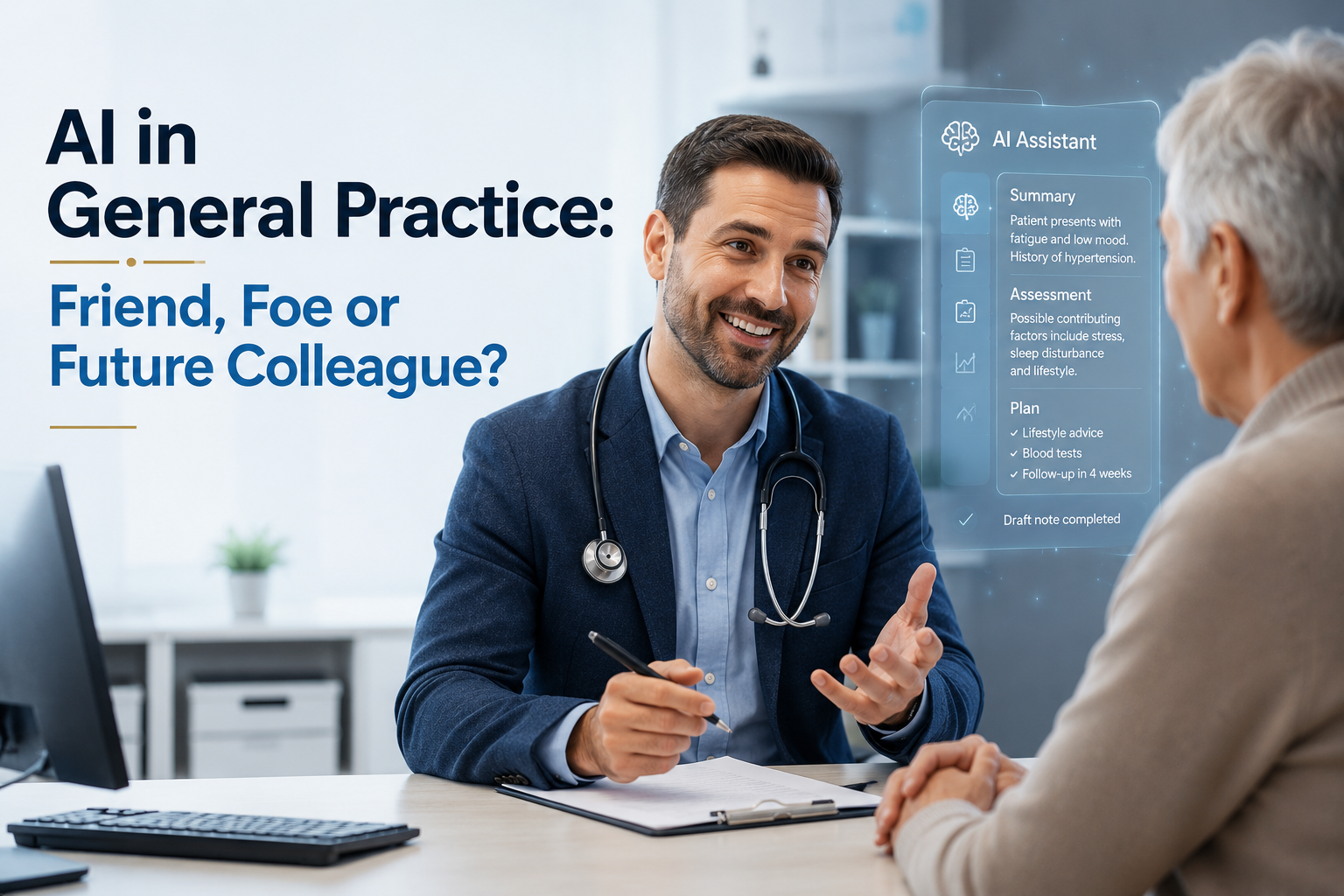
"Will AI replace doctors?" It's one of the most common questions I hear whenever artificial intelligence comes up in conversation. My answer is usually the same. No. At least not in the way people imagine.
Patients don't come to see a GP because they need information. Most of that information already exists online. They come because they need someone to interpret it, apply it to their situation, understand their concerns and help them make decisions. That's the part AI still struggles with.
However, another question is worth asking: will doctors who use AI outperform doctors who don't? That is becoming much harder to dismiss.
AI Has Already Arrived
Many people imagine artificial intelligence as a future technology. In reality, it is already quietly working inside thousands of medical practices. Most commonly, AI appears in the form of:
- Clinical scribes.
- Documentation assistants.
- Letter drafting tools.
- Referral generators.
- Information retrieval systems.
- Clinical decision support tools.
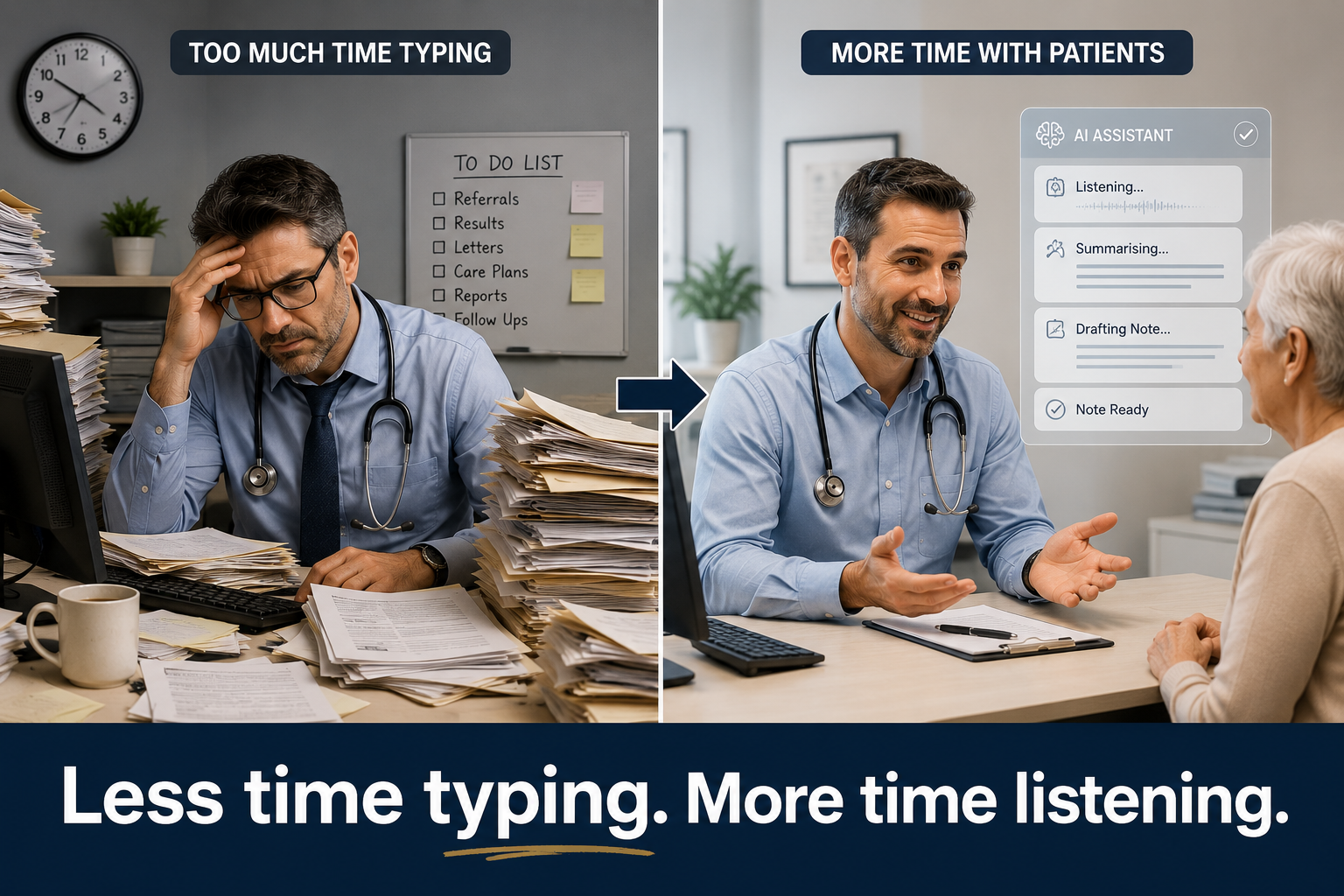
Instead of spending the consultation staring at a keyboard, many clinicians can now focus more attention on the patient while AI assists with documentation in the background. For a profession drowning in paperwork, that's a significant development.
The Administrative Burden Nobody Talks About
Patients often see the fifteen-minute consultation. They don't see the work surrounding it — the referrals, the care plans, the insurance forms, the letters, the endless documentation requirements. Many GPs spend hours every week completing tasks that add little value to patient care but remain essential to modern healthcare.
This is where AI may have its greatest immediate impact. Not by replacing clinical judgement. By reducing administrative friction. Every minute spent less on typing is potentially a minute spent listening.
What AI Does Well
Artificial intelligence excels at certain tasks. It can:
- Summarise large volumes of information.
- Organise clinical notes.
- Draft letters.
- Identify relevant guidelines.
- Create patient information sheets.
- Produce educational material.
- Generate structured documentation.
It never gets tired. It never complains about repetitive tasks. And it can process information at a speed no human can match. Used appropriately, these strengths can make clinicians more efficient.
What AI Does Poorly
This is the part that often gets overlooked. AI can sound intelligent without actually understanding anything. It predicts words. It doesn't think. That distinction matters.
An AI system may produce a beautifully written referral letter that contains a factual error. It may sound confident while being completely wrong. In medicine, confidence and accuracy are not the same thing. And sometimes the errors are subtle — one example frequently discussed involves a consultation mentioning lithium, which was transcribed as sodium. A single word. A potentially dangerous mistake.
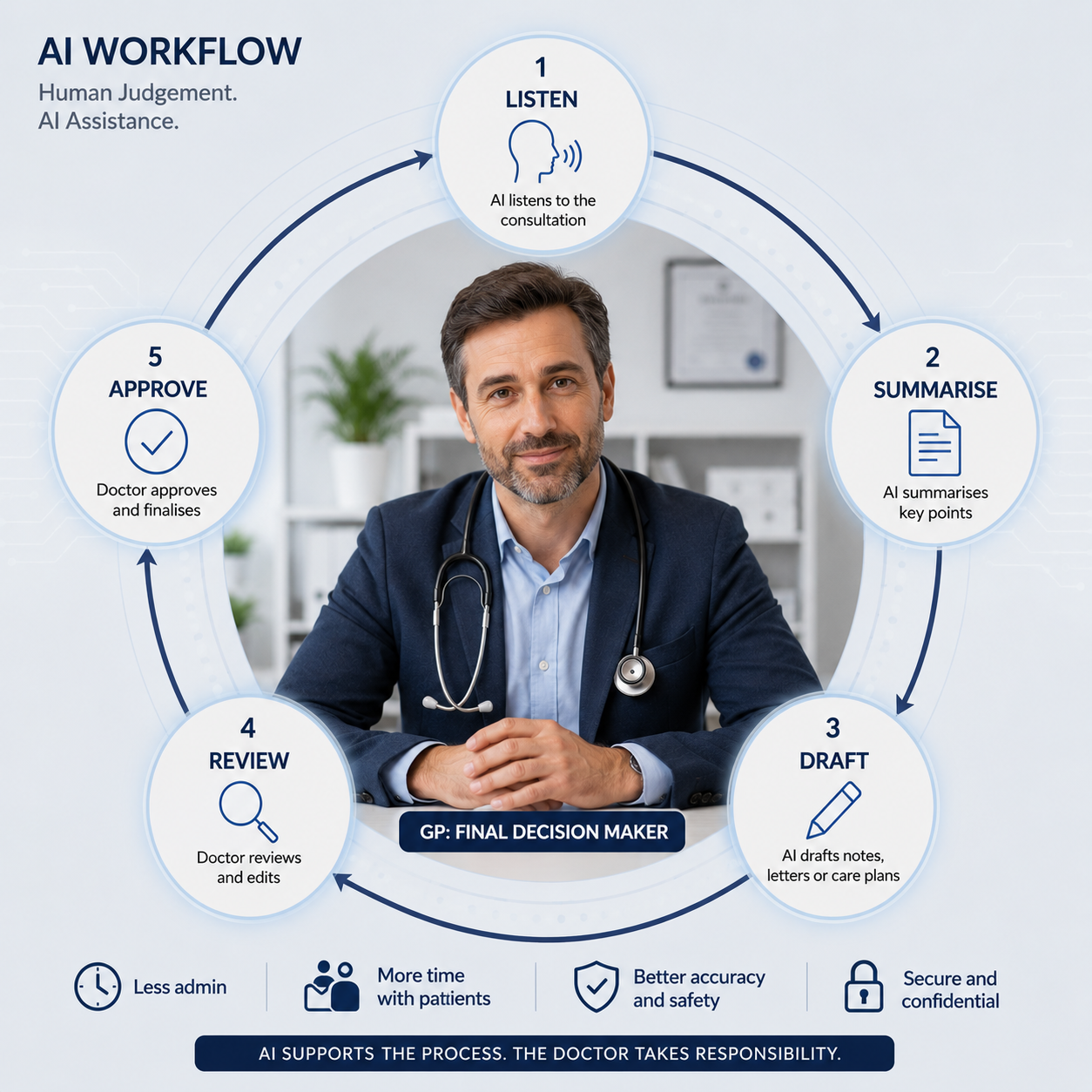
The lesson is simple: AI can help create documents. Humans remain responsible for checking them.
The Real Risks
Whenever new technology arrives, enthusiasm can sometimes outrun caution. There are genuine concerns that need careful consideration.
- Privacy — patient information must remain secure; clinicians need to understand where data is stored and how it is used.
- Hallucinations — AI systems can occasionally generate information that sounds plausible but is incorrect.
- Bias — AI reflects the data on which it was trained; biases can be inherited and amplified.
- Over-reliance — the greatest risk may be clinicians gradually trusting AI more than they trust their own judgement.
Technology should support thinking, not replace it.
What This Means for Patients
The good news is that patients may benefit long before they realise AI is involved. Potential advantages include:
- More eye contact during consultations.
- Better documentation.
- Faster letters and referrals.
- Improved access to information.
- Reduced administrative delays.
In the best-case scenario, patients simply experience a smoother and more focused consultation. The technology fades into the background. The human interaction remains at the centre.
What This Means for Doctors
The reality is that medicine is becoming increasingly complex. Guidelines change constantly. Medical knowledge expands every day. Administrative demands continue to grow. AI may help clinicians manage that complexity more effectively.
The doctors most likely to thrive are unlikely to be those who ignore AI entirely. Nor will they be those who blindly trust it. The future probably belongs to clinicians who learn how to use AI wisely while maintaining professional judgement.
The Future Is Bigger Than Scribes
Most current discussions focus on AI scribes because they are easy to understand. But scribes are probably only the beginning. Future systems may assist with:
- Risk prediction.
- Preventive care.
- Population health management.
- Personalised treatment recommendations.
- Clinical workflow automation.
What This Means for the Future of General Practice
General practice has always adapted. We've moved from paper records to electronic records. From handwritten referrals to digital communication. From encyclopaedias to online guidelines. AI is simply the next step in that evolution.
The goal should not be to replace doctors. The goal should be to free doctors to spend more time doing the things only humans can do — listening, explaining, reassuring, supporting, caring.